Got a Quote from a Korean Clinic? 6 Things to Check Before You Confirm
Quotes from Korean clinics often list just item names and a total. Here are 6 questions to ask before you confirm: what is and is not included, follow-up visits, touch-up conditions, extra charges if the plan changes, and cancellation rules and documents.

Before you confirm a quote from a Korean clinic, it is safer to check six things: whether the listed items and number of sessions match what you discussed, whether tests, anesthesia and medication are included, how many follow-up visits are covered, what the conditions are for a touch-up, how charges might change if the plan changes, and how cancellation and documents are handled. A quote usually shows item names and a total, and cost increases usually come from details that are not written down.
Mediport is not a medical institution. This article explains how to read a quote. It does not cover which treatment is right for you or what a reasonable fee would be. Treatment and fees are set and explained by the medical institution that treats you.
What a quote usually shows and what it leaves out
Most of the cosmetic, plastic surgery and dental care that international patients receive in Korea is non-covered care, meaning national health insurance does not apply. Korea's Medical Service Act, Article 45, requires clinics to disclose non-covered fees in a way patients can easily understand, and prohibits charging more than the disclosed amount. That makes a quote a useful record in itself. Still, a legal duty to disclose fees is not the same as having every condition written on one page.
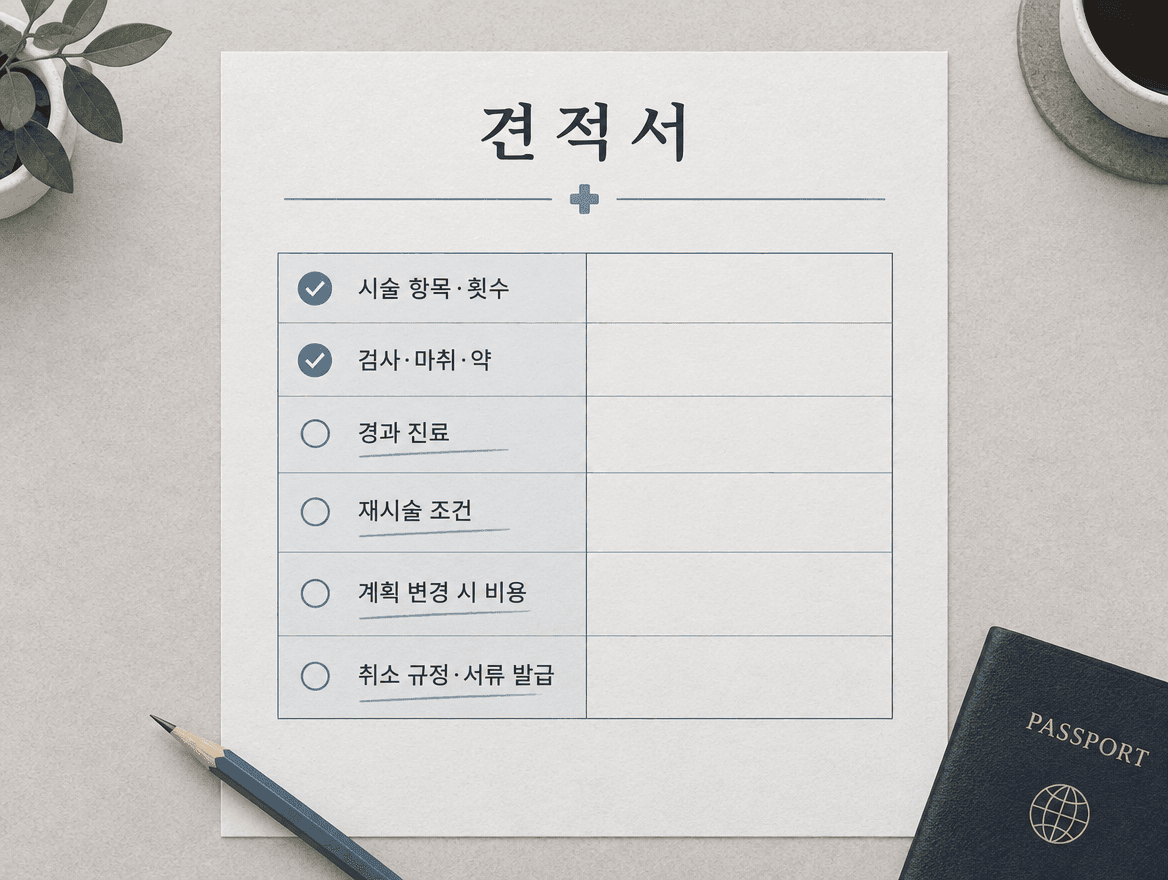
What you usually see on a quote is the procedure name, the treatment area and the total. Some things tend to come up in consultation messages or in conversation and never make it onto the quote: the number of follow-up visits, touch-up conditions, parts that may change depending on test results on the day of treatment, cancellation rules, and documents for your trip home. The table below sets out the difference at a glance.
| What to check | Is it usually on the quote? | What can happen if you don't ask | How to ask |
|---|---|---|---|
| 1. Procedures and number of sessions | Usually listed | The number of sessions on the quote may differ from what you heard in consultation | How many sessions is this quote based on, and which materials or products will you use? |
| 2. Tests, anesthesia, medication, supplies | Varies by clinic | Same-day tests or prescription medication may be billed separately | Are tests, anesthesia and prescription medication included in this amount? |
| 3. Follow-up visits | Often left out | You may need to book stitch removal or check-ups separately | How many follow-up visits are included, and until when? |
| 4. Touch-up and revision conditions | Often left out | If the result is not what you expected, there is no agreed standard and the conversation gets harder | In what cases is a touch-up possible, who decides, and what does it cost? |
| 5. Charges if the plan changes | Rarely listed | If in-person tests differ from the photo consultation, the plan changes and so does the amount | If the plan changes after tests, at what point will you explain it to me again? |
| 6. Cancellation rules and documents | Varies by clinic | You may be caught off guard by how a deposit is handled when dates change, or by fees for English documents | Please tell me your cancellation and rescheduling rules and how to get an English medical certificate or doctor's report. |
The middle columns describe a general pattern and differ from clinic to clinic. What matters is filling in the blanks before you confirm.
1. Do the procedures and number of sessions match your consultation?
Start by comparing the item names and session counts on the quote with what you were told in consultation. The quote is built on details like how many sessions a skin treatment includes, how many teeth a dental treatment covers, or which areas a surgery includes. Procedures with the same name can differ depending on the materials or products used, so you can ask the clinic to write down which ones by name. If something differs from what you heard in consultation messages, ask right away. Once you arrive, there is little time to change things.
2. Are tests, anesthesia, medication and supplies included?
Sometimes a quote lists the procedure fee but leaves out what is needed before and after it: tests on the day of treatment, anesthesia, prescription medication afterward, and supplies such as ointment or a protective dressing. Whether these are included varies by clinic, so this is not a question with one right answer. It is a question to confirm. Asking in a single sentence, "What is included in this amount and what is charged separately?", usually gets a clear reply.
3. How many follow-up visits are included, and until when?
This matters most if you are traveling from abroad. Whether the quote covers the visits you need while in Korea, such as a check the day after the procedure, stitch removal a few days later, or a progress check a week later, affects both your schedule and your costs. Ask how many visits are included and until when, and check that those dates fall before your flight home. It also helps to ask at this point where to send questions that come up after you get home.
4. What are the conditions for a touch-up or revision?
Asking ahead about what happens if the result is not what you expected is preparation, not suspicion. Check whether a touch-up or revision is possible, and if so, until when after the procedure, who decides whether it is needed, and what it costs. These conditions vary widely by clinic and procedure, and in some cases a repeat procedure is not medically advised. So the goal is not to expect a set answer but to get that clinic's own standard in writing.
5. If the plan changes, how might the cost change?
Most quotes given to patients abroad are based on photos and messages. When the doctor examines you and runs tests on the day of treatment, the plan may change, and you will receive a revised quote. That is not a mistake. It is a limit of photo consultations. Before you confirm, ask two things: whether you will be informed again before the procedure if the plan changes, and what happens if you do not agree to the revised plan. For how to prepare when a plan changes, see When the plan changes.
6. Cancellation and rescheduling rules, and documents for your trip home
Flights change, and sometimes you need to postpone because of how you are feeling. If there is a deposit, check before you confirm how it is handled depending on when you change your booking. Ask about documents at the same time. If you need an English medical certificate, a doctor's report or a receipt to show a doctor back home, ask whether the clinic can issue them, when you can get them, and whether there is a separate fee. Korean medical law requires clinics to post the fees they charge for issuing certificates. For which records are worth taking with you, see Records to take home.
How to send your questions and keep the answers
If asking all six at once feels like a lot, you can copy and send the questions below as they are.

- How many sessions (or treatment areas) is this quote based on, and which materials or products will you use?
- Are any tests, anesthesia, prescription medication or supplies not included in this amount?
- How many follow-up visits are included, and until when?
- What are the conditions and charges if a touch-up or revision is needed?
- If the plan changes after tests on the day of treatment, will you explain it to me again before the procedure?
- Please tell me your cancellation and rescheduling rules and how to get English documents.
Get the answers in a form that stays on record, such as messages or email, and keep them with the quote. When something is said aloud through an interpreter, each side may remember it differently later.
What Mediport does
Mediport is a government-registered foreign patient facilitator in Seoul (registration number A-2026-01-01-07030, Portzone Inc.). We do not set or negotiate prices. Medical fees are set and explained by the medical institution. What we do is pass the six questions above to the clinic in a language you are comfortable with, summarize the answers for you, and interpret during your appointment. If you already have a quote, you can send it with the amounts covered, and we will help you see which questions are still open.
Frequently asked questions
- Q. Do Korean clinic quotes include follow-up visits?
- A. It depends on the clinic and the procedure. Visits you need while in Korea, such as a check the day after the procedure or stitch removal, are included in some quotes and charged separately in others. Before you confirm, ask how many follow-up visits are included and until when, and check that those dates fall before your flight home.
- Q. Can a quote based on photos change on the day of treatment?
- A. Yes, it can. Most quotes given to patients abroad are based on photos and messages. If the doctor examines you and runs tests on the day and the plan changes, you will receive a revised quote. Ask in advance whether you will be informed again before the procedure if the plan changes, and what happens if you do not agree to the revised plan.
- Q. Can I be charged more than the quote?
- A. Korea's Medical Service Act, Article 45, requires clinics to disclose non-covered fees in a way patients can easily understand and prohibits charging more than the disclosed amount. However, if the plan itself changes after tests, you will receive a new explanation. That is why it matters to get in writing, along with the quote, what is included and what is charged separately, and to keep it.
- Q. Does Mediport compare clinic quotes or adjust prices?
- A. No. Mediport is not a medical institution and does not compare clinics or set prices. Medical fees are set and explained by the medical institution. Mediport passes the questions you want answered to the clinic in a language you are comfortable with, summarizes the answers, and interprets during your appointment.
This article is for general information only. Results vary by individual, and whether a procedure is suitable is a physician's decision. Please ask in a free consultation for details.
Related articles



How consultation & interpretation work
Start with a free consultation
Tell us your goals, schedule and concerns. We'll reply within 24 hours, in your language.
Start a free consultation