Taking Your Prescribed Medication Home Without Trouble
How to get medication prescribed in Korea safely back to your own country. What an English prescription is for, the difference between carry-on and checked baggage, and the rules in your home country you need to check before you fly.
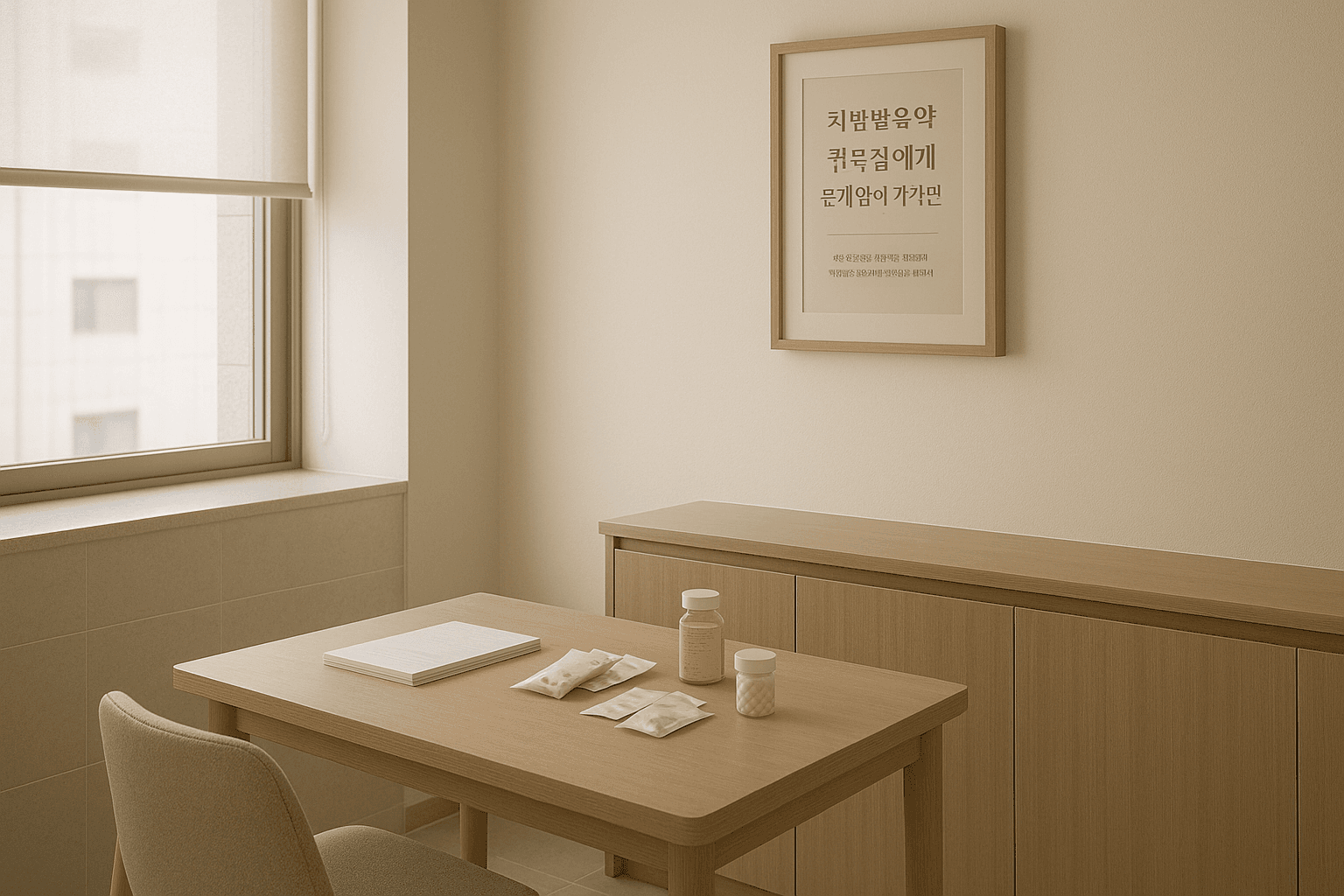
When treatment ends, you usually leave with anything from a few days to a few weeks of medication. But the moment that medication goes into your suitcase, you have moved from healthcare into customs. You may be asked to explain what you are carrying, and occasionally items are held at the border. This guide covers what to arrange in advance so that the medication you received in Korea travels home with you without difficulty.
What happens if you travel with the pharmacy bag alone
Medication dispensed at a Korean clinic normally comes with the drug name and dosing instructions written in Korean. That is sufficient inside the country, but the situation changes the moment you cross a border. A customs officer who cannot read the label has no straightforward way to see what the medication is or why you have it.
Loose tablets, unlabelled containers, and pills removed from their original packaging all invite more questions. Where possible, keep the medication in the packaging you received it in, and do not discard the pharmacy bag or label.
What an English prescription actually does
A prescription or medical certificate in English is a document showing that a doctor prescribed this medication for you specifically. It usually carries your name, the diagnosis or procedure, the drug's ingredient name, and how long you are to take it.
It is considerably more useful when it lists the generic ingredient name rather than only a brand name. The same medication is sold under different brand names in different countries. If you later see a doctor at home, an ingredient name makes that conversation far easier.
This document can take time to issue if you request it after your appointment has finished. If your departure date is already fixed, it is safer to request it on the day of your appointment.
Carry-on versus checked baggage
Medication that has to be taken at set times, and medication you would struggle without, is better carried in the cabin. Checked bags can be delayed or lost, and temperature swings in the hold are not ideal for some medicines.
Liquids, ointments, and eye drops may run into volume restrictions, so check in advance. Medicines are often handled differently from ordinary liquids, but even then you should be able to show a prescription or a doctor's note alongside them.
If you have been given injectables or anything requiring refrigeration, ask specifically on the day of your appointment about storage and how to maintain temperature while travelling.
Rules differ from country to country
This is the part that matters most. What you may bring in, and how much, is decided by the rules of the country you are returning to. Medication legally prescribed in Korea may still require separate authorisation at home, or may be restricted entirely.
Differences are largest for sleep medication, certain analgesics, and anything classified as psychotropic. Because these rules change regularly, this article will not state any particular country's threshold as fact. What it can do is tell you where to check before you fly.
- Your country's customs authority or medicines regulator, and its guidance for travellers carrying medication
- Your airline's guidance on carrying medication
- If you have a layover, the rules of the transit country as well
Checking can take time, so start when your treatment finishes rather than the night before departure.
Where Mediport helps
We explain how to request the documents you will need during your treatment, and we support communication with the medical team through interpretation. If you need an English prescription or medical certificate, we help make sure that request reaches the clinic on the day of your appointment.
There is one thing we want to be clear about. We do not determine whether a medication may be brought into your country. That belongs to national regulations and customs authorities. What we do is make sure nothing on your checklist gets missed, and pass your requests to the clinic in your own language.
If questions about your medication come up after you return home, please get in touch then as well. The end of treatment is not the end of the connection.
Frequently asked questions
- Q. When should I request an English prescription?
- A. It is safest to request it on the day of your appointment. Requesting it afterwards can mean waiting for it to be issued, and if your departure is close you may end up leaving without it. Mention it during your consultation and we will help make sure the request is passed on.
- Q. Can I repack my medication out of its original packaging?
- A. We recommend keeping it in the packaging you received wherever possible. The label and pharmacy bag carry the drug name and prescription details, which is what supports your explanation at the airport of what you are carrying and why. If you need to reduce bulk, keep the labels with you at least.
- Q. What if the medication is not permitted in my country?
- A. Whether it may be brought in is decided by the rules of the country you are returning to, and it is not something we can determine for you. Check your national authority's guidance before you fly, and if an ingredient is restricted, tell the medical team during your appointment so alternatives can be discussed.
- Q. I was given medication that needs refrigeration. How do I travel with it?
- A. Storage temperature and how to maintain it while travelling vary by medication, so confirm this directly with the medical team on the day of your appointment. If your journey home is long, mention that too so the guidance fits your situation. We can support with interpretation if needed.
This article is for general information only. Results vary by individual, and whether a procedure is suitable is a physician's decision. Please ask in a free consultation for details.
Related articles


How consultation & interpretation work
Start with a free consultation
Tell us your goals, schedule and concerns. We'll reply within 24 hours, in your language.
Start a free consultation