Where to Stay After Treatment in Korea: Distance, Check-Out and Rooms
After a procedure, dental work or eye treatment in Korea, choose where to stay for the next few days by three things: how easily you can get back to the clinic, whether check-in and check-out fit your treatment and flight times, and whether the room and neighborhood let you rest. Here is what to check before you book, in one table.

After a procedure, dental work or eye treatment in Korea, you can choose where to stay for the next few days by looking at three things. Can you get back to the clinic by a short, simple route on the days you need to return? Do the check-in and check-out times fit your treatment schedule and your flight home? Will the room and the area around it let you lie down and rest without trouble? During recovery, these conditions shape each day more directly than the atmosphere or star rating of the place. Below, the points to check before you book are set out in a table, with what to ask the property about each one.
First, one thing to be clear about. Mediport is not a medical institution, and it is not a travel agency. We do not book accommodation or recommend specific hotels; this article is a general guide to the conditions worth checking when you choose a place to stay. The final guidance on how to rest and what to be careful about after treatment comes from the medical institution that treated you. Medical fees are set by the medical institution, and Mediport does not set or compare prices.
What to get from the clinic first, and the criteria at a glance
Before you start searching, get two things from the clinic and choosing becomes much easier. The first is the clinic's exact address: the Korean address, the building name and the floor. The second is the days, and roughly the times, you need to go back to the clinic after treatment. Whether you need to return, for example for a check-up or stitch removal, depends on the procedure and your own condition, so ask the medical team directly during your consultation. Once these two are settled, the location and the number of nights are mostly decided.
The table below lists what to check when choosing a place to spend the days after treatment. Not every row applies to everyone, so pick the rows that match your treatment and schedule.
| Criterion | Why it matters after treatment | What to check when booking |
|---|---|---|
| Distance and travel to the clinic | A long trip on a return day is more tiring and adds to the worry about being late | Walking and taxi time from the clinic's address; on public transport, the number of transfers |
| Check-in and check-out times | You may finish treatment with no room to go to yet, or have nowhere to stay before your flight home | Check-in and check-out times, whether early check-in and late check-out are possible, luggage storage |
| Elevator and stairs | Carrying luggage up and down stairs is a strain | Whether there is an elevator; stairs at the building entrance and on your floor |
| Quiet and light | You may need to lie down and rest during the day too | Whether the room faces a main road or a busy area, blackout curtains, dimmable lights |
| Fridge | The clinic may tell you to keep a medication cool | Whether the room has a fridge and whether you can keep your own items in it |
| Resting position and washing | The clinic may give separate instructions on how to rest or wash | Extra pillows, a chair to sit back in, a handheld shower |
| Pharmacy and convenience store | You may need a prescription or everyday items right away | A pharmacy and convenience store within walking distance, and their hours |
| Food that is easy to eat | If the clinic gives food instructions, you need to be able to follow them | Nearby restaurants, whether delivery reaches the address, a microwave |
| Laundry | Over several days you may need to wash clothes and towels | In-room or shared washer, laundry service, a self-service laundromat nearby |
| Companion | You will share a room with the person coming with you | Number of beds, terms for adding a guest |
| Changes and cancellation | It is not unusual for plans to change after a clinic visit | Deadline for free changes or cancellation, whether you can extend your stay |
Distance to the clinic and how you get there
When you look at distance, look at how you will actually get there and how long it takes rather than the straight line on the map. Put the clinic's address into a map app and check, one by one, the walking time from the property, the taxi time and the public transport route. If you can walk, you depend less on the weather and traffic.
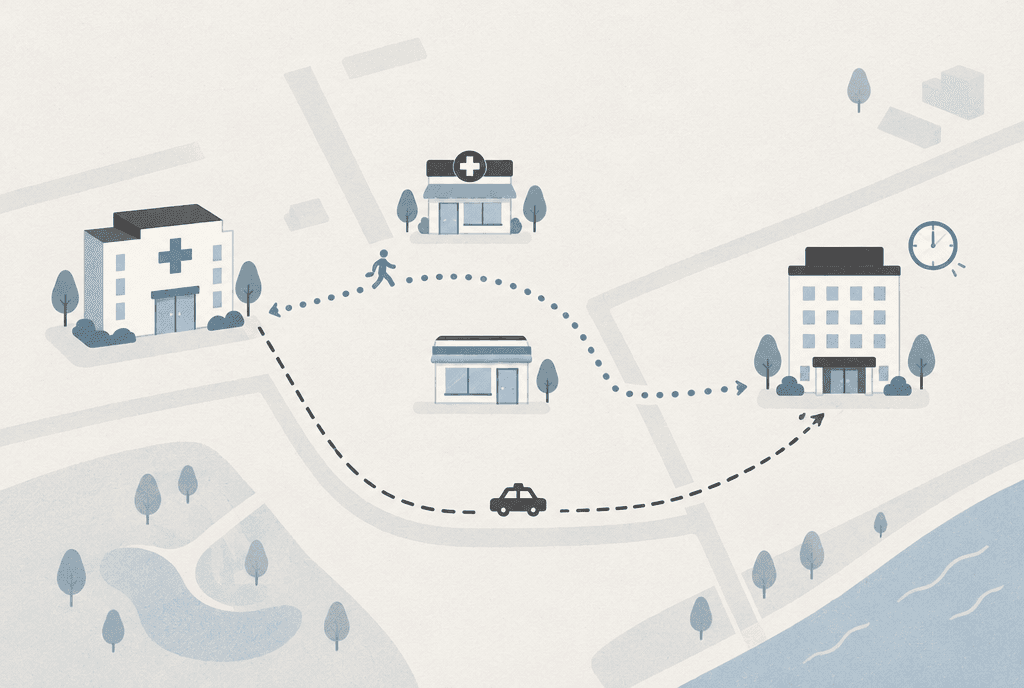
On the day of treatment and the few days after, you may not be able to move around as you normally do. On days like these, a route with several subway transfers or a station with long stairs becomes a burden. If you plan to take taxis, also check whether it is easy to catch one outside the property and whether the roads nearby jam at rush hour. In central Seoul, the same distance can take very different amounts of time depending on the time of day.
Before you plan a long trip to the airport or another city on the day of treatment, first ask the medical team when long-distance travel and flying will be fine for you. Until you have the answer, a plan that leaves at least a day of slack near the clinic is easier to change later.
Right next to the clinic is not always the easiest choice. If the clinic sits in the middle of a busy district, places close by can be noisy until late at night. A quiet side street a few minutes' walk away is sometimes better for resting.
Matching check-in and check-out to your treatment and flight
It varies by property, but many set check-in in the afternoon and check-out in the morning. If your treatment is in the morning and you are checking in for the first time that day, there will be a gap after treatment when you cannot get into your room yet. You can stay from the night before, or ask when you book whether early check-in is possible. If neither works, leave your bags first and decide where you can sit and rest until check-in.
The same problem comes up on the day you fly home. If you check out in the morning and fly in the evening, you need somewhere to spend half a day. Check in advance whether late check-out is possible, whether you can leave your bags after checking out, and whether you can wait in the lobby. Leaving some time between your last check-up and your flight home makes it easier to cope if the schedule slips. What to do when plans change is covered separately in When the Plan Changes.
If you arrive late at night, check whether the front desk is open overnight, or whether it is a self check-in with a door code and no staff. This also affects whether you can tell staff right away if you need help during your stay.
Inside the room: what you need to rest
Elevators get left off the list more often than you might think. Older buildings and small properties sometimes have no elevator, or a few steps at the building entrance. Picture the days you will carry large bags, check the photos and description, and if it is unclear, ask the property directly.
If you will be lying down to rest during the day, quiet and light become important. Noise differs depending on whether the room faces a main road or sits right next to the elevator. When you book, ask whether you can request a room on the quieter side, and check for blackout curtains and lights you can dim.
For the fridge, the clinic's instructions come first. Follow the medical institution that treated you on how to store your medication, and if you are told it needs to be refrigerated, ask the property whether the room has a fridge and whether you can keep your own items in it. If the room has no fridge, you can also ask whether the property can store it for you.
If the clinic has given you separate instructions on how to rest or wash, see whether the room lets you follow them: whether you can get extra pillows, whether there is a chair to sit back in besides the bed, and whether the shower head can be held in your hand. You may need to message or video-call the clinic, so also check that the room's internet works well.
Around the property: pharmacy, food, laundry, and urgent situations
A pharmacy and a convenience store within walking distance make it easy to pick up a prescription or everyday items. Pharmacy hours in Korea differ from one to the next, so look up the hours of pharmacies near your place in advance. Pharmacies open at night or on holidays can be found with the pharmacy search on E-Gen, run by the National Emergency Medical Center. Hours can change, so E-Gen itself advises calling the pharmacy before you go. E-Gen's search screens are in Korean, so if you need to, ask the property's staff or your companion to look it up with you.
It also helps to decide on food by looking at the area around the property. Depending on the procedure, the clinic may give you instructions about food, and following them is easier if suitable food is close by and simple to get. See whether there are restaurants or convenience stores nearby selling soft food, whether food delivery reaches the property's address, and whether there is a microwave in the room or a shared space. To use delivery, you need the property's Korean address and your room number.
If you stay more than a few days, think about laundry too. Check whether there is a washer and dryer in the room or a shared space, whether there is a laundry service, and whether there is a self-service laundromat nearby.
In case something urgent comes up, save the following in your phone.
- The clinic's name, Korean address and phone number
- How to contact the clinic after hours (ask the clinic during your consultation)
- The property's name, Korean address and your room number
- 119 for emergencies
- For non-urgent interpretation or travel information, the Korea Tourism Organization's 1330 Korea Travel Helpline (1330 within Korea, +82-2-1330 from overseas)
According to the Korea Tourism Organization, you can call 119 to reach the fire service in an emergency. You can look up the emergency rooms closest to your place in advance with the emergency room search on E-Gen. After any urgent care, let the clinic that treated you know what happened as well.
When you book: one place, together, and changeable
During recovery after treatment, a plan to stay in one place the whole time is simple. Moving means packing, checking out, traveling and checking in somewhere new all on the same day, and learning a new route to the clinic. If you also want to travel around Korea, one option is to put the travel-heavy part of the trip before treatment and stay in one place near the clinic afterward. Ask the medical team when it is fine to start traveling.
If someone is coming with you, the first thing to check is whether you can share one room. See how many beds there are and whether the terms change if you add a guest. If your companion can handle trips to the pharmacy and the shops, you will not have to go out alone right after treatment. How to split the schedule with a companion is covered in Coming Alone, or Bringing Someone.
Be sure to read the change and cancellation terms as well. Test results or how you feel can move your treatment date, or you may need one more night for a check-up. Before you book, check the deadline for free changes or cancellation and whether you can extend your stay, and if the rate is non-refundable, choose it knowing that.
What Mediport does
Mediport is a government-registered foreign patient facilitator in Seoul (registration number A-2026-01-01-07030, Portzone Co., Ltd.). We are not a travel agency, so we do not book accommodation. Instead, once your treatment schedule is set, we put together the days and times you need to go back to the clinic and the clinic's Korean address, and explain in a language you are comfortable with which of the criteria above to check when you choose a place to stay. You are welcome to ask which areas make it easy to get to the clinic. You book the place yourself, and for how to rest and what to watch for after treatment, follow the guidance of the medical institution that treated you.
Frequently asked questions
- Q. Do I need to stay right next to the clinic after treatment?
- A. Not necessarily. What matters is whether you have days when you need to go back, and how short and simple the trip is on those days. Being able to walk is convenient, but if the clinic is in a busy district, a quieter place a little farther away may be better for resting. Confirm any return visits with the medical team during your consultation.
- Q. Does Mediport book or recommend accommodation?
- A. No. Mediport is not a travel agency, so we do not book accommodation or recommend specific hotels. We put together your return-visit schedule and the clinic's address and explain what to check when you choose a place to stay. You make the booking yourself.
- Q. What if my treatment ends before check-in time?
- A. Stay from the night before, or ask the property when you book whether early check-in is possible. If that is not possible, leave your bags first and decide where you will rest until check-in. Check whether late check-out is possible on the day you fly home in the same way.
- Q. If I am told to keep a medication refrigerated, what should I check with the property?
- A. Follow the medical institution that treated you on how to store it. In line with those instructions, ask in advance whether the room has a fridge, whether you can keep your own items in it, and, if there is no fridge, whether the property can store it for you. Also check with the medical team before you leave Korea how to carry the medication on your way home.
- Q. Who do I contact if I suddenly feel very unwell at my accommodation?
- A. If it is urgent, call 119. The Korea Tourism Organization also lists 119 for emergencies. You can find nearby emergency rooms and open pharmacies on E-Gen (Korean-language screens), run by the National Emergency Medical Center, and for non-urgent interpretation or travel information you can use the 1330 Korea Travel Helpline (+82-2-1330 from overseas). Once you are stable, let the clinic that treated you know as well.
This article is for general information only. Results vary by individual, and whether a procedure is suitable is a physician's decision. Please ask in a free consultation for details.
Related articles

How consultation & interpretation work
Start with a free consultation
Tell us your goals, schedule and concerns. We'll reply within 24 hours, in your language.
Start a free consultation