Problems After Treatment in Korea? Insurance, Contacts and Mediation
If a problem comes up after a procedure or treatment in Korea, you can contact the clinic that treated you, with your records in hand, get help from a public help desk, and apply for mediation at the Korea Medical Dispute Mediation and Arbitration Agency. Here is what to check about clinic and travel insurance before you book, how foreigners apply, and the deadlines set by law.

If you feel something has gone wrong after a procedure or treatment in Korea, the starting point is to contact the clinic that treated you, with your records in hand, and to keep what you exchange in writing. If talking to the clinic does not resolve things, you can ask a public help desk for foreign patients for support, and the next step after that is applying for mediation at the Korea Medical Dispute Mediation and Arbitration Agency (K-medi). Foreigners can apply, and if you live abroad, you apply by email or fax. For this sequence to actually help you, there are two things to check before you book: whether the clinic is registered with the government to attract foreign patients, and whether your travel insurance applies to the planned procedure and its complications.
This article is general information based on official sources, not legal advice. Mediport is not a medical institution, and we do not decide who is responsible in a medical dispute. Medical fees are set by the medical institution, and Mediport does not set or compare prices. For an individual case, please talk to the official bodies listed below or to a legal professional.
Before you book: the clinic's insurance and yours
In Korea, a medical institution that wants to attract foreign patients must register with the mayor or provincial governor under Article 6 of the Act on Support for Overseas Expansion of Medical Services and Attraction of Foreign Patients (the Medical Overseas Expansion Act). One registration requirement is medical malpractice liability insurance or membership in a medical liability mutual aid association. Another is having at least one specialist in each department that will see foreign patients (departments that are not among the specialties set out in the regulations are exempt). Registration must be renewed every three years. That makes registration an official way to gauge whether a clinic has insurance or mutual aid in place to pay compensation if something goes wrong. We explain how to check it in How to check if a Korean clinic is registered for foreign patients.
The same law also gives registered institutions a duty to inform. Article 8 requires them to prepare a separate explanation for foreign patients covering the diagnosis, the treatment method, possible side effects, the treatment contract and estimated fees, and the dispute resolution procedure if a medical accident occurs. Asking before you book, "Could I have your dispute resolution procedure in advance?", is not a rude question. It is information the law says you should be given. Facilitators that connect clinics and patients must also register, and registration requires surety insurance (Article 6(2) of the same law).
Your own insurance matters too. In its guidance on cosmetic surgery abroad, the UK's NHS explains that travel insurance does not normally apply if something goes wrong with surgery. The US CDC also notes that treating complications after a procedure abroad can be costly and that your health insurance at home may not pay for it. Check whether the exclusions in your policy list planned procedures, cosmetic procedures or their complications, and if the wording is unclear, ask your insurer and get the answer in writing.
| What to check before booking | Where to check | Why it matters |
|---|---|---|
| Is the clinic registered to attract foreign patients? | The registered clinic search on the official Medical Korea website, or ask the clinic for its registration number | Registration requires medical malpractice liability insurance or membership in a medical liability mutual aid association |
| Is the registration certificate displayed at the clinic? | Around the reception desk when you visit | The law requires the certificate to be displayed where anyone can see it (Article 8(1)) |
| Can you get the dispute resolution procedure explained? | Ask the clinic in writing | Registered institutions must give this information to foreign patients |
| Is the agency introducing you (the facilitator) registered? | The registered facilitator search on the official Medical Korea website | Registration requires surety insurance |
| Does your travel insurance apply to the planned procedure and its complications? | The exclusions in your policy, and a written answer from your insurer | Travel insurance does not normally apply to problems related to surgery |
| Will insurance apply to treatment you receive back home? | Your health insurance at home, and your insurer | Treatment for complications mostly continues after you return home |
If a problem comes up, follow this order
If your symptoms are urgent, treatment comes before any dispute process. If you are in Korea, go to a nearby emergency room. If you are back home, see a local medical provider. The steps below are for after you have received urgent care, or for when it is not urgent but you are worried about the result or how your recovery is going.
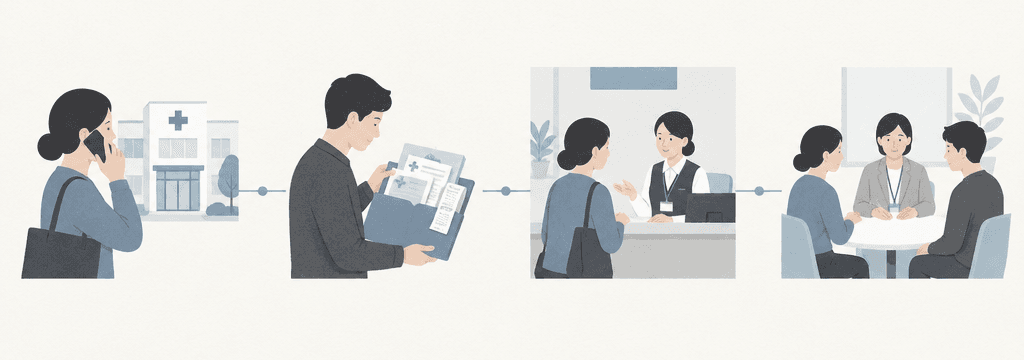
- Contact the clinic that treated you, describe the situation and ask for an explanation
- Collect records such as medical records, receipts, messages and photos
- If it is hard to resolve with the clinic, consult a public help desk for foreign patients
- If needed, apply to K-medi for mediation or arbitration
Not every case goes as far as step 4. Some are settled at step 1 with a follow-up appointment or a further explanation. But if you keep records from step 1, you will not have to start collecting from scratch if steps 3 and 4 become necessary.
Contact the clinic that treated you first, and keep it in writing
The medical team that treated you holds the full record of the procedure and how it has progressed. When you get in touch, write down when the symptoms started, what they are and how things are now, with dates, and send photos taken under the same conditions if you have them. Then say clearly what you want, such as a date for a follow-up visit, a medical report or letter for your doctor at home, or an explanation of what to do next.
Do not rely only on conversations by phone or through an interpreter. Ask for anything important to be sent again by message or email. Explanations given aloud can be remembered differently by each side later. It is a situation where emotions can run high, but a message that sticks to facts and dates will be useful at any office you take it to later.
Collecting records: what to keep and how
Article 21 of Korea's Medical Service Act says patients can ask to view or get copies of records about themselves, and a medical institution cannot refuse without a legitimate reason. On the other hand, a medical institution cannot show records or give copies to anyone other than the patient. If a family member or a representative chosen by the patient wants to make the request instead, they need the patient's own consent form and documents proving the family relationship or their authority to act (paragraphs 2 and 3 of the same article). Copies of medical records are the basic material both at public help desks and in mediation.
Here is what is worth keeping: copies of medical records and test results, receipts for medical fees, signed documents such as the treatment contract or consent forms, the messages you have exchanged with the clinic from booking until now, dated photos of your recovery, and prescriptions and a list of the medicines you took. If you saw a doctor after returning home, keep those records too. For documents worth getting while you are still in Korea, see The records to take home with you.
One thing to know in advance: K-medi says that when you apply by email, documents must be written in Korean, and English documents must come with a Korean translation. If you also ask for the Korean originals while collecting your records, you will have less to translate.
Public help desks you can turn to
There are official help desks that foreign patients can consult first when talking to the clinic does not resolve things. The official Medical Korea website, run by the Korea Tourism Organization (KTO) and the Korea Health Industry Development Institute (KHIDI), lists the Medical Korea Information Center. It has desks at Seoul Station (Airport Railroad, basement level 2) and Incheon International Airport Terminal 1, and the website says it offers consultations on difficulties using Korean medical institutions, consultations on medical complaints and disputes, support with referrals to K-medi, and consultations about illegal brokers. Phone consultation (Medical Call) is +82-2-1577-7129, every day from 09:00 to 18:00 Korea time. The Seoul center lists English, Chinese, Japanese and Korean, and the Incheon Airport center adds Russian (official website, as of October 2026).
K-medi also runs its own counseling center. According to its official website, the medical dispute counseling center is 1670-2545 (weekdays 09:00 to 18:00), and from abroad it lists +82-2-1670-2545 or +82-2-6210-0080 (shown at the bottom of its English website). You can download an English mediation application form from the English website. Phone numbers and hours may change, so check each official website once more before you get in touch.
How K-medi mediation works
K-medi is the body that mediates and arbitrates disputes arising from medical accidents under Korea's Act on Remedies for Injuries from Medical Malpractice and Mediation of Medical Disputes (the Medical Dispute Mediation Act). Foreign patients can apply too. According to its official English guidance, foreign patients living in Korea apply online, by email or by fax, and foreign patients living abroad apply by email or fax. You submit the application form, supporting documents, a consent form for the collection and use of sensitive information, and a copy of your ID. If someone other than you applies, a power of attorney and proof of relationship are also needed. There is an application fee, and the application is accepted only after payment is confirmed. For any refund of the fee, you are asked to give a Korean bank account, and K-medi notes that if you give an overseas account, it will not make up differences caused by transfers or exchange rates. The law allows foreigners and others to appoint as their representative someone who has received written authority from them (Article 27(2)).
The overall flow is as follows. Once an application is received, K-medi sends it to the clinic concerned. If the clinic says within 14 days of receiving it that it will take part in mediation, the process begins. If it does not, the application is dismissed. However, for medical accidents involving death, unconsciousness of one month or more, or severe disability as defined by law, the process begins right away without the clinic's consent (the clinic may file an objection within 14 days if it has grounds set out in the law). The rule on the clinic's notice of participation is set to change under an amendment passed in May 2026. From 27 May 2027, the application will be dismissed if the clinic says within 14 days that it will not take part, and if it says nothing, it will be treated as having agreed to mediation. Medical accidents caused by high-risk essential medical care will also be added to the cases where the process begins right away. Once the process begins, an expert appraisal panel examines the medical accident, and the mediation panel makes a mediation decision taking that opinion into account. If both sides reach an agreement along the way, the case can also end on those terms.
| Stage | Period set by law | Basis (Medical Dispute Mediation Act) |
|---|---|---|
| Applying for mediation | Within 10 years from the end of the act that caused the medical accident, and within 3 years of learning of the harm and who caused it | Article 27(13) |
| The clinic's notice of participation | Within 14 days of receiving the application (dismissed if there is no notice; starts automatically for death, serious injury and similar cases). From 27 May 2027, the clinic is treated as agreeing if it gives no notice of refusal | Article 27(8) and (9) |
| Expert appraisal report | Within 60 days from the start of the process, extendable once by up to 30 days | Article 29 |
| Mediation decision | Within 90 days from the start of the process, extendable once by up to 30 days | Article 33 |
| Telling K-medi whether you accept the decision | Within 15 days of receiving the written decision; treated as acceptance if you say nothing | Article 36(2) |
The 60 and 90 days in the table are legal processing limits, not the average time a case actually takes. Some periods, such as the time needed to diagnose a lasting disability, are not counted toward these limits (Article 42-2), so it can take longer in practice.
People living abroad should pay particular attention to the last row. If you do not respond within 15 days of receiving the decision, you are treated as having accepted it, and a mediation that both sides accept has the same effect as a settlement in court (Article 36). Give an accurate email address and postal address for contact, and check them often.
A few more points are worth knowing. If you have already filed a lawsuit, or applied to Korea's Consumer Dispute Settlement Commission over the same matter, your K-medi application will be dismissed (Article 27(3)). On the other hand, you can also go straight to court without mediation (Article 40). If both sides agree in writing to follow the mediation panel's decision, you can apply for arbitration, and an arbitral award has the same effect as a final court judgment (Articles 43 and 44). Which route is right depends on the case, so please talk to the counseling center or a legal professional before deciding.
What Mediport does
Mediport is a government-registered foreign patient facilitator in Seoul (registration number A-2026-01-01-07030, Portzone Co., Ltd.). At the booking stage, we check whether the clinic is registered and ask the clinic for documents worth having in advance, such as its dispute resolution procedure and the treatment contract. If something worries you after treatment, we listen to what happened in a language you are comfortable with and pass it on to the clinic that treated you, explain how you yourself can request copies of your medical records, and tell you where the official help desks above are. We do not obtain records on a patient's behalf. Medical judgments and judgments about responsibility belong to the medical team and the official bodies, and we do not reach conclusions in their place.
Frequently asked questions
- Q. Can foreigners apply for mediation at the Korea Medical Dispute Mediation and Arbitration Agency?
- A. Yes. According to its official English guidance, foreign patients living in Korea apply online, by email or by fax, and foreign patients living abroad apply by email or fax. Documents must be written in Korean, and English documents must come with a Korean translation. There is an application fee, and the application is accepted after payment is confirmed.
- Q. Can travel insurance pay for treating complications after a procedure?
- A. It depends on the policy, but the UK's NHS says travel insurance does not normally apply if something goes wrong with surgery. Before you book, check whether the exclusions in your policy list planned procedures, cosmetic procedures or their complications, and if it is unclear, ask your insurer in writing and keep the answer.
- Q. Can I still apply for mediation after I have gone home?
- A. Foreign patients living abroad can apply by email or fax. The Medical Dispute Mediation Act requires you to apply within 10 years from the end of the act that caused the medical accident, and within 3 years of learning of the harm and who caused it. If you do not say whether you accept a mediation decision within 15 days of receiving it, you are treated as having accepted, so check the email address you gave often.
- Q. What is different about a clinic registered to attract foreign patients?
- A. To register under Article 6 of the Medical Overseas Expansion Act, a clinic must have medical malpractice liability insurance or membership in a medical liability mutual aid association, and at least one specialist in each department that will see foreign patients (departments not among the specialties set out in the regulations are exempt). Under Article 8, it must also give foreign patients a separate explanation of the diagnosis, the treatment method, possible side effects, the treatment contract and estimated fees, and the dispute resolution procedure in case of a medical accident. Registration means the requirements are met. It does not mean the government has evaluated treatment results.
- Q. Does Mediport judge or settle disputes with clinics?
- A. No. Mediport is not a medical institution and does not judge responsibility in medical disputes. We listen to what happened in a language you are comfortable with and pass it on to the clinic that treated you, tell you how you yourself can request copies of your medical records (for someone else to receive them for you, the patient's consent form and authorization documents are needed), and point you to official help desks such as the Medical Korea Information Center and K-medi.
This article is for general information only. Results vary by individual, and whether a procedure is suitable is a physician's decision. Please ask in a free consultation for details.
Related articles



How consultation & interpretation work
Start with a free consultation
Tell us your goals, schedule and concerns. We'll reply within 24 hours, in your language.
Start a free consultation