Paying at a Korean Clinic as a Foreign Patient: Card or Cash, Deposits, Receipts for Insurance, and the VAT Refund in 2026
Medical fees at Korean clinics are usually paid by credit card or in Korean won cash. This guide covers what to check before and after you pay: deposit cancellation terms, how to request receipts, itemized bills and medical certificates for an insurance claim, and where the cosmetic surgery VAT refund that ended in late 2025 stands now (as of October 2026).
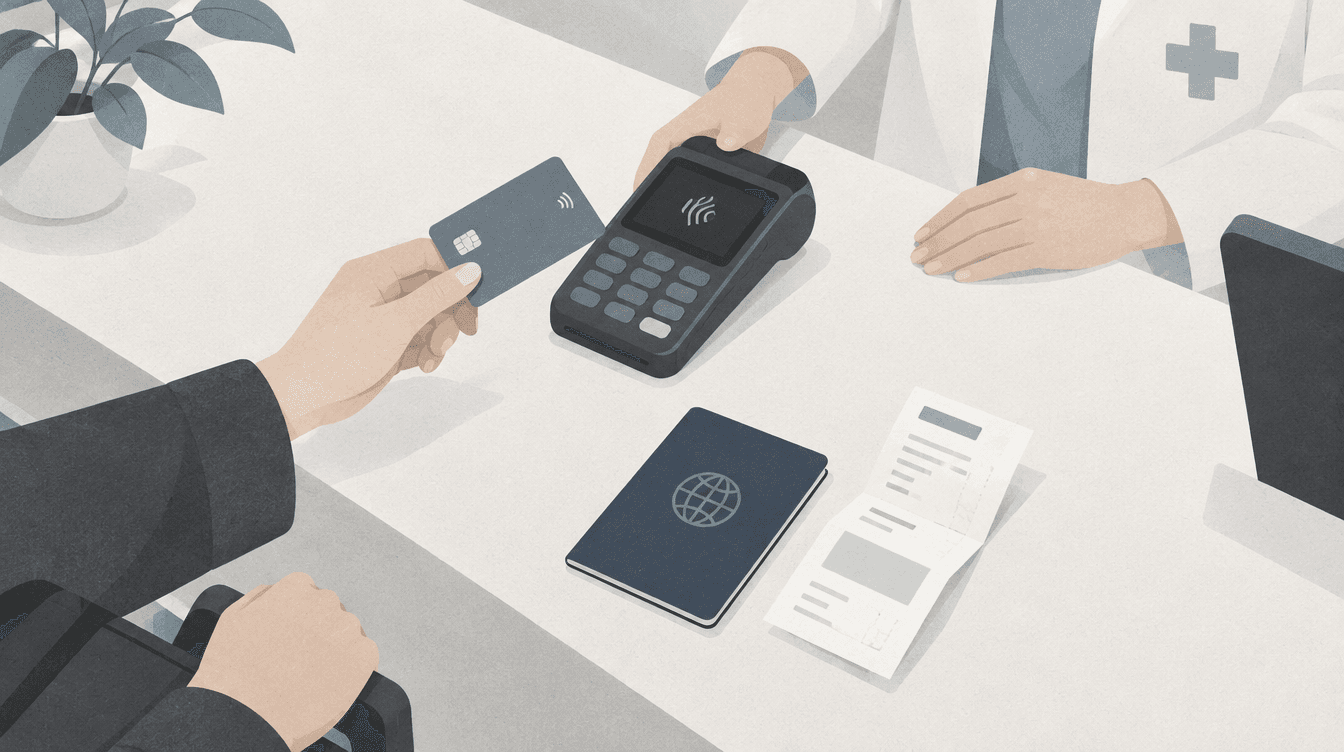
Medical fees at Korean clinics are usually paid by credit card or in Korean won cash. Three checks before you fly make the day of treatment much easier: whether the clinic accepts your card, how a deposit is handled if you change your dates, and whether you can get the documents you need for an insurance claim back home in English. The tax refund that used to return VAT to foreign tourists on cosmetic and plastic surgery treatment is limited by law to treatment "received by December 31, 2025," so as of October 2026 it does not apply to new treatment.
Mediport is not a medical provider, and it is not a financial institution or a tax agent. This guide sets out the order in which to prepare payments and paperwork; it does not cover amounts or exchange rates. Medical fees are set by the medical institution, and Mediport does not set or compare prices. The law described here is the text in force as checked on Korea's National Law Information Center (law.go.kr) on October 30, 2026, and the details will change if the law changes.
What to check before you pay, at a glance
Splitting the checks into when you book, before you fly, on the day you pay, and after you pay makes it less likely that something slips.
| When | What to check | Why it matters |
|---|---|---|
| When you book | Whether there is a deposit, how to pay it, and the cancellation and change terms | This is where the rules for a change of dates are set |
| When you book | Which payment methods the clinic accepts (card networks, cash and so on) | If your card is not accepted, you will have to find another way on the day |
| Before you fly | Your card issuer's overseas payment settings and limits, and the number that receives verification texts | A payment may be declined, or you may miss the verification text |
| Before you fly | The list of documents your insurer requires for a claim | Match what you request from the clinic to this list |
| Before you fly | Whether English documents are available, the issuing fee, and how many days they take | Leave every request to the last day and some documents will not be ready |
| On the day you pay | Whether to pay in won or in your home currency | You choose this yourself on the card terminal screen |
| After you pay | Receipt, itemized bill, card authorization record | Used for your insurance claim and for checking later |
Card or cash: how to pay medical fees
The Korea Tourism Organization says most businesses in Korea, including hotels, department stores and ordinary shops, accept credit cards, and that Visa, Mastercard, American Express and others can be used. The same guide notes that some shops may not accept cards and suggests checking in advance. Clinics are no different. When you book, ask whether you can pay with your card's network, and bring a second card on a different network so you have a fallback if one is declined.
Your card issuer's settings are also worth checking before you fly. If overseas payments are blocked, or your daily or per-transaction limit is low, a payment for treatment may be declined. Tell your card issuer you will be using the card in Korea and confirm your limits. Some issuers send a verification text or app notification when you pay. If you take out your usual SIM and use a different one in Korea, you will not receive texts sent to your usual number, so ask your issuer whether you can switch verification to app notifications.
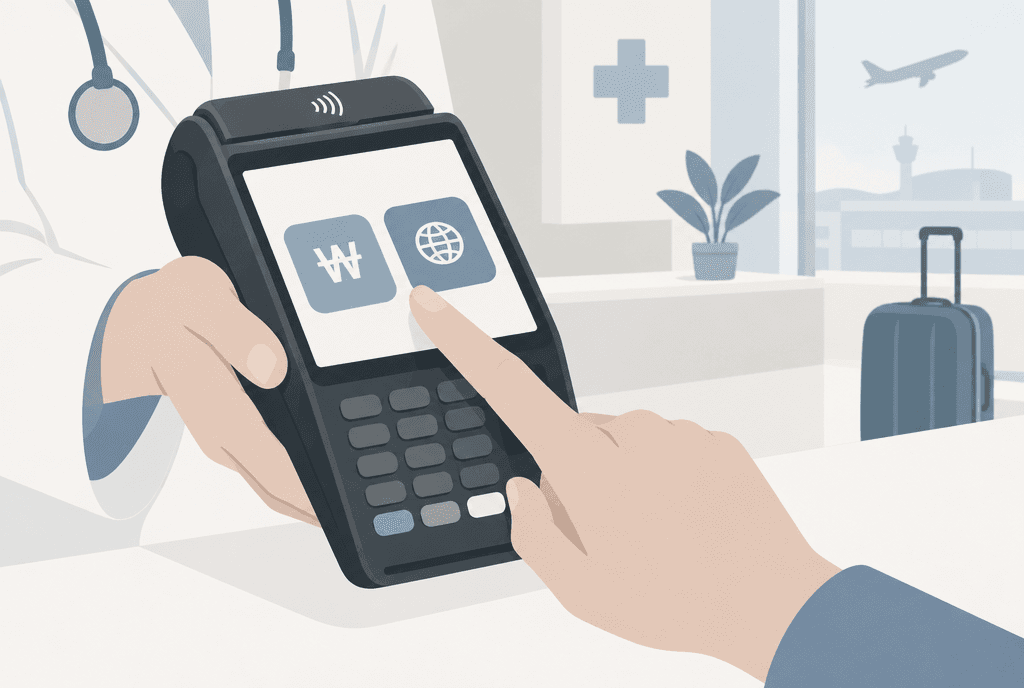
When you pay with a foreign card, the terminal may ask whether to charge in won or in your home currency. Visa calls this conversion into your home currency Dynamic Currency Conversion (DCC) and explains that it includes an exchange rate and an extra fee. The same guidance says the choice belongs to the cardholder, the merchant must not make it for you, and if the information you need is not shown or you feel pressured to pick one option, you should decline and report it to your card issuer. Which option suits you depends on your card issuer's terms, so ask your issuer before you travel. Mediport does not compare exchange rates or cards.
If you plan to pay cash, you will need Korean won. The Korea Tourism Organization advises exchanging foreign currency at banks or licensed exchange offices, and notes that banks usually open on weekdays from 09:00-16:00, though hours vary by bank and region. Incheon Airport has bank branches and exchange counters you can use as soon as you land; they usually operate from 06:00-22:00, and some are open 24 hours. If you pay cash, make sure you get a receipt on the spot. Paying by card also leaves a record on your card statement, which is useful when you file an insurance claim.
Deposits and prepayment: terms before amounts
Some clinics take a deposit to confirm a booking or ask you to pay before treatment. Whether a clinic takes a deposit, and how much, is up to the clinic. What you should look at before confirming is the terms, not the amount. Send these questions at the booking stage.
- Is the deposit deducted from the treatment fee, or paid separately?
- If you change or cancel your dates, by when, and how is it handled?
- If you decide not to go ahead with treatment after the tests on the day, what happens?
- How can you pay from abroad (a card payment link, a bank transfer and so on), and is the payee the clinic itself?
- Will you get a receipt or confirmation after you pay?
Get the answers in a form that leaves a record, such as a message or an email. If the payee's name is not the clinic's, it is safer to confirm the reason once more through the clinic's official contact details. If you pay a deposit, keep that receipt together with your treatment receipts.
The deposit belongs with the quote. Questions to check alongside it, covering what is and is not included, follow-up visits and the fees if the plan changes, are in Got a Quote from a Korean Clinic? 6 Things to Check Before You Confirm.
Receipts and billing documents: if you plan to claim on insurance
Which documents an insurance claim needs varies by insurer and by policy. So the order is to get your insurer's list of documents before you fly, and then request documents from the clinic to match that list. The US CDC says the expense of procedures abroad is usually paid out of pocket and that insurance commonly does not cover it. If the treatment is cosmetic, first check with your insurer whether it is covered at all. The same CDC guidance recommends asking for English copies of your medical records from abroad and getting your complete records before you return home.
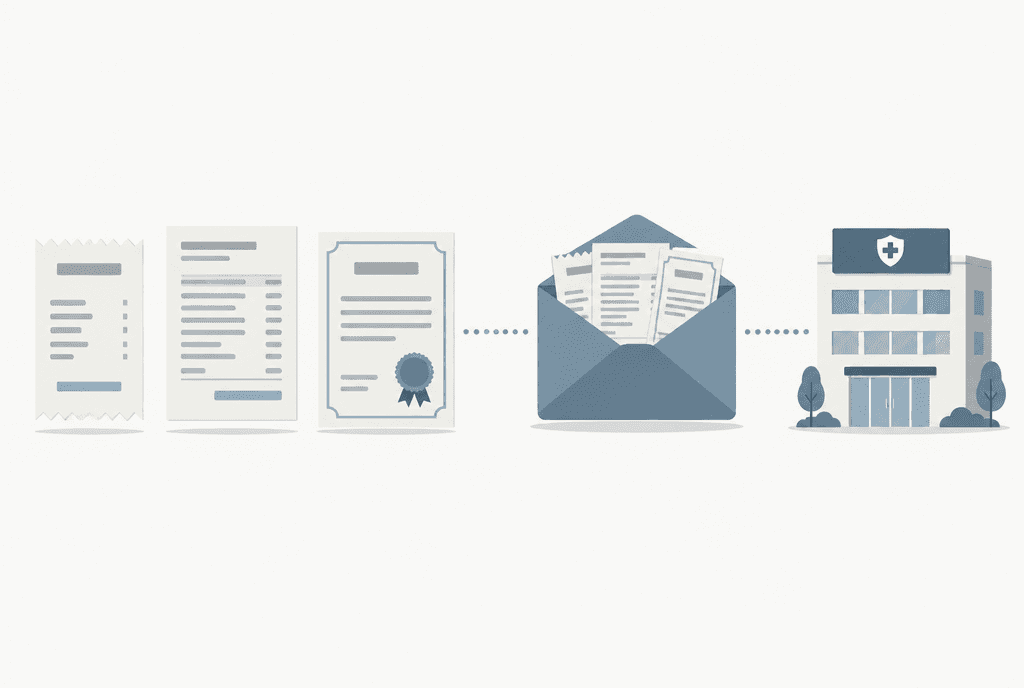
| Document | What it shows | What it is for | What to check when you request it |
|---|---|---|---|
| Receipt | Treatment date, what was paid, payment method | Proof of payment | That the spelling of your name matches your passport |
| Itemized bill | Treatment broken down by item | When the insurer reviews individual items | Whether it is available in English |
| Medical certificate | Diagnosis and opinion written by the examining doctor | Insurance claim, follow-up care at home | How many days it takes and the fee |
| Doctor's letter or treatment confirmation | Course of treatment and the doctor's opinion | Explaining your treatment to your doctor at home | Pass on the items your insurer requires in advance |
| Copies of medical records | Test results, treatment and procedure records | Care at home and later decisions | Decide the period and scope you need before requesting |
A medical certificate is written by the doctor who examined you in person (Korea's Medical Service Act, Article 17). You can ask to view your own medical records or get copies, and a medical institution cannot refuse without a legitimate reason (Medical Service Act, Article 21). Article 45 of the Medical Service Act requires medical institutions to post their fees for issuing certificates and prohibits charging more than the posted amount. Whether English versions are available, and how many days they take, varies by clinic, so ask about this when you book.
Insurers match documents by name. Ask the clinic to spell your name in English on every document exactly as it appears in your passport. Checking on the spot that the treatment date is the same on every document also cuts down on having to request them again later. Documents you will need for follow-up care at home, such as your medical records and medication details, are covered separately in The Records to Take Home With You.
VAT refunds on cosmetic and plastic surgery: not available in 2026
Article 35 of Korea's Enforcement Decree of the Value-Added Tax Act excludes plastic surgery such as double eyelid surgery and nose surgery, and treatments such as melasma and acne treatment, hair removal and skin whitening, from VAT-exempt medical services. That means VAT may be included in the fees for these treatments.
The scheme that used to return this VAT to foreign tourists is the special VAT refund for cosmetic and plastic surgery medical services received by foreign tourists, set out in Article 107-3 of Korea's Restriction of Special Taxation Act. It was introduced at the end of 2015 and extended several times, but the text in force, as checked on the National Law Information Center on October 30, 2026, limits it to medical services "received by December 31, 2025." Treatment received in 2026 is not eligible for this refund. The same article requires a refund to be claimed within three months of the date of treatment, so the deadline has also passed for treatment received in 2025.
There are reports that a bill to reinstate this special refund was introduced in the National Assembly in August 2026. As of October 30, 2026, however, the text of the law has not changed, and if the refund does return, the start date and eligibility will be set anew. Travel guides and blog posts written before 2026 may still say that medical services qualify for a refund. Do not build your plans around a refund; check with the clinic just before your visit whether anything applies now.
The tax refund on shopping (tax-free shopping) is a separate scheme. According to the Korea Tourism Organization, the goods must be bought at a participating tax refund store, you need a separate tax refund slip in addition to the receipt, and medicines are excluded. Whether something you buy at a clinic or pharmacy qualifies depends on whether the place is a participating store and whether the item is a medicine, so ask on the spot.
On the day you pay, in this order
On the day of treatment, you will usually be paying after your consultation and treatment, when you are tired. Deciding the order in advance makes it less likely that something slips.

- Before paying, compare the items on the bill with what you were told in the consultation. Ask about anything you do not recognize there and then, through your interpreter.
- If the card terminal shows a currency choice screen, make the choice yourself.
- Collect the receipt and itemized bill, and check the spelling of your name and the dates.
- Request a medical certificate or doctor's letter to match your insurer's list, and agree on the date you will collect it.
- Photograph the receipts and documents and save them on your phone, and keep the originals together in one envelope. Put the deposit receipt in too.
Once you are home, check the entries on your card statement against your receipts. If anything differs, contact the clinic using the receipt as your reference.
What Mediport does
Mediport is a government-registered foreign patient facilitator in Seoul (registration number A-2026-01-01-07030, Portzone Co., Ltd.). We do not set or negotiate medical fees, and we do not compare exchange rates or cards. At the booking stage, we ask the clinic, in the language you are comfortable with, which payment methods it accepts, the terms of any deposit, and which documents you will need after you return home and whether they are available in English, and we put the answers together for you. Send us the list of documents from your insurer and we will request them from the clinic to match it. You can reach us through messaging apps such as LINE or WhatsApp. For final decisions on tax and insurance claims, check with the relevant authorities and your insurer.
Frequently asked questions
- Q. Can I pay with a foreign card at a Korean clinic?
- A. The Korea Tourism Organization says most businesses in Korea accept credit cards such as Visa, Mastercard and American Express, but notes that some may not. Clinics differ in the cards they take, so ask when you book whether you can pay with your card's network, and bring a second card on a different network. Before you fly, also check your card issuer's overseas payment settings and limits.
- Q. When I pay, should I choose won or my home currency?
- A. There is no single answer; it depends on your card issuer's terms. Visa explains that paying in your home currency (DCC) includes an exchange rate and an extra fee, that the choice belongs to the cardholder, and that the merchant must not make it for you. Ask your card issuer before you travel which suits you, and make the choice yourself on the terminal screen.
- Q. Can I get my deposit back?
- A. Every clinic has its own rules. Before you confirm, ask whether the deposit is deducted from the treatment fee, how a change or cancellation is handled and by when, and what happens if you decide not to go ahead after the tests on the day, and get the answers by message or email. Keep the receipt for any deposit you pay.
- Q. Can I get my insurance claim documents in English?
- A. Whether English versions are available, how many days they take and whether there is an issuing fee varies by clinic. Korea's Medical Service Act requires medical institutions to post their fees for issuing certificates. Get your insurer's list of documents before you fly, pass it to the clinic when you book, and ask for your name to be spelled in English exactly as it is in your passport.
- Q. Can foreign tourists still get a VAT refund on plastic surgery or skin treatments?
- A. Not as of October 30, 2026. Under the text in force, the special refund in Article 107-3 of the Restriction of Special Taxation Act covers only treatment received by December 31, 2025, and it must be claimed within three months of treatment, so the deadline for 2025 treatment has also passed. There are reports of a bill to reinstate it, but the law has not changed, so check with the clinic before your visit whether anything applies now.
This article is for general information only. Results vary by individual, and whether a procedure is suitable is a physician's decision. Please ask in a free consultation for details.
Related articles


How consultation & interpretation work
Start with a free consultation
Tell us your goals, schedule and concerns. We'll reply within 24 hours, in your language.
Start a free consultation